

Chiropractor vs Physiotherapist: What’s the Difference & Which Should You See?
Written by Maya Smith | Clinical reviewer: Dr. Joshua Smith Doctor of Chiropractc
Published 30 September 2026 · Updated 13 October 2026 · Last clinically reviewed 17 November 2026
Table of Contents
“What’s actually the difference between a chiropractor and a physio?”
We get asked this a lot here at Life Balance.
Usually because, from the outside, they can look pretty similar.
Both work with the body. Both may see people with back pain, neck pain, joint problems or movement issues. Both can use hands-on treatment. Both may give you things to work on at home.
So it’s easy to lump them together.
But chiropractic and physiotherapy aren’t the same thing.
The main difference is emphasis. Chiropractors focus particularly on the spine, joints and musculoskeletal system, while physiotherapists have a broader role in movement, physical function and rehabilitation. There is considerable overlap: both may use exercise, advice and hands-on treatment, so the right choice depends on your individual needs and goals.
So, which should you see? If you need rehabilitation after an injury or operation, physiotherapy may be a sensible first step. For common back, neck or joint problems, either a chiropractor or a musculoskeletal physiotherapist might be appropriate. Your symptoms, medical history, goals and the individual practitioner matter more than the job title.
And the difference isn’t simply:
chiropractor = adjustments
physio = exercises
That misses quite a lot.
Here at Life Balance, chiropractic is about looking at how your spine is moving, how your body is functioning and how the nervous system relates to movement and symptoms. That describes our assessment focus; it is not a claim that adjustments treat unrelated health conditions.
People come to us for different reasons. Some are in pain, some keep noticing the same stiffness or restriction coming back, and some simply want to understand how their spine and movement are functioning before something becomes a bigger issue.
Physio often has a different focus, particularly around rehabilitation, rebuilding strength and helping someone regain movement or function after an injury, operation or illness.
There’s crossover, of course.
But people may choose them for different reasons, and sometimes either profession could help.
Dr. Hope Beales, one of our chiropractors here at Life Balance, explained it like this when we interviewed her:
“I’m really positive about physio. I see lots of people who work with a physio as well as seeing us. They can work really nicely together”
“What we’re looking at from a chiropractic point of view is how the spine is moving and functioning, and the relationship with the nervous system. Someone doesn’t necessarily need to be injured or in lots of pain for that to be valuable.”
So rather than trying to decide which profession “wins”, it makes more sense to understand what each one actually does.
Chiropractor vs Physiotherapist: What’s the Main Difference?
Chiropractors work particularly with the spine, joints and musculoskeletal system.
At Life Balance, our chiropractic approach has a particular focus on the spine and musculoskeletal system, while also considering how movement, pain, stress and the nervous system interact. That is a description of how we assess patients, not evidence that chiropractic treatment improves every aspect of nervous-system health.
Physiotherapists work with movement and physical function across a much wider range of settings. That can include injury rehabilitation, post-operative recovery, neurological rehabilitation, hospital care and sports.
The General Chiropractic Council (GCC) regulates chiropractors in the UK. It explains that chiropractic can include spinal and joint manipulation, other manual techniques, exercise and lifestyle advice.
Physiotherapists are regulated by the Health and Care Professions Council (HCPC.
So yes, there’s overlap.
You could see a chiropractor and be given exercises.
You could see a physio and receive hands-on treatment.
The difference tends to become clearer when you look at why somebody is going in the first place.
| Chiropractor | Physiotherapist | |
|---|---|---|
| Main clinical emphasis | Spine, joints and musculoskeletal function | Movement, physical function and rehabilitation |
| Common reasons people attend | Back pain, neck pain, joint problems, sciatica, recurring stiffness or movement restriction | Injury rehabilitation, recovery after surgery or illness, strength, mobility and return to activity |
| Treatment may include | Spinal or joint manipulation, mobilisation, exercise, self-management and lifestyle advice | Exercise rehabilitation, movement retraining, manual therapy, self-management and advice |
| Typical approach | Often focuses particularly on assessing and managing spinal and joint function within the wider musculoskeletal system | Often focuses on restoring movement, strength and physical function following injury, illness or surgery |
| Where you commonly find them | Mainly private chiropractic and healthcare clinics | NHS, hospitals, private clinics, rehabilitation and sports settings |
| UK regulator | General Chiropractic Council (GCC) | Health and Care Professions Council (HCPC) |
| Can the professions overlap? | Yes | Yes |
The important point: these aren’t hard boundaries. Some chiropractors use considerable exercise and rehabilitation, while physiotherapists may use manual therapy and spinal manipulation. The practitioner’s individual approach, your health history and what you actually need help with matter as much as the professional title.
At a Glance: Which Professional Might Be Right for You?
The guide below is a starting point, not a diagnosis. If you have an injury, persistent pain or anything worrying, an individual assessment can help you choose the right next step.
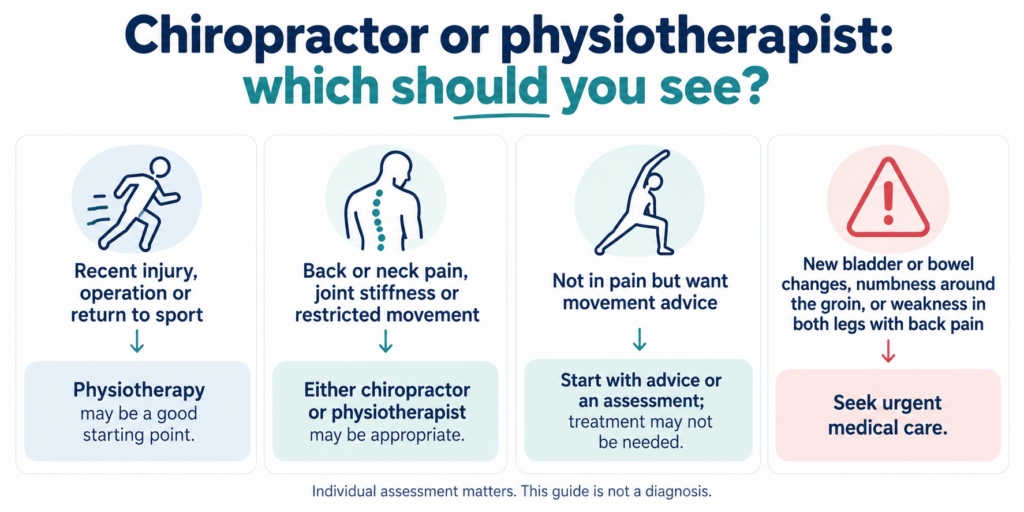
Recent injury, surgery or return to sport? Physiotherapy is often a sensible starting point for structured rehabilitation. Back or neck pain, stiffness or joint symptoms? A musculoskeletal physiotherapist or chiropractor may be appropriate. Feeling well but curious about your movement? Advice or assessment may be enough; treatment may not be needed. New bladder or bowel problems, numbness around your genitals, or weakness in both legs with back pain? Seek urgent medical help.
You Don’t Have to Be in Pain to See a Chiropractor
This is probably one of the biggest things we’d change about the way chiropractic is talked about.
People often assume:
“I’ll see a chiropractor when my back goes.”
And yes, pain is one reason people come through our door.
But it’s not the only reason.
Some people come because they keep feeling stiff.
Some notice that the same area always feels restricted.
Some have finished dealing with an injury and want to keep looking after how they’re moving.
Others feel perfectly well and simply want to be proactive about their health.
You don’t have to wait until something is screaming at you and you don’t have to be in pain to speak to a chiropractor.
Some people seek an assessment because they have recurring stiffness, notice changes in movement, want advice about their musculoskeletal health or simply want to understand what’s going on before deciding whether they need care.
That doesn’t mean everyone who feels well needs chiropractic treatment.
Whether any care is appropriate should depend on the person’s history, assessment, preferences and goals.
What Does a Chiropractor Actually Do?
If your only experience of chiropractic comes from social media, you could be forgiven for thinking it’s mostly dramatic cracks.
The difference at Life Balance isn’t that we believe every problem is caused by your spine. It isn’t.
It’s that we don’t want to start with a treatment. We start with the person.
We want to understand what you’re experiencing, what it is stopping you doing, what you’ve already tried, what matters to you and whether chiropractic is actually appropriate.
What’s been happening?
How long has it been happening?
Has anything changed recently?
What do you notice when you move?
Is there something you can’t do as comfortably as you’d like?
What have you already tried?
And what are you actually hoping to get from coming here?
Then we assess.
Our approach pays particular attention to the relationship between spinal movement, the musculoskeletal system and relevant nerve symptoms. We look closely at how different areas of your spine are moving, whether anything feels restricted or different from side to side, and whether those findings relate to match what you’ve been noticing day to day.
Adjustments may be part of someone’s care.
Depending on what we find, we may also talk about movement, exercise, home care and things somebody can do outside the clinic.
And no, not everybody receives the same thing.
Two people can both arrive saying ‘my back hurts’ and need completely different conversations, because their history, what triggers it and how it affects their life may be completely different.
Someone saying “my back hurts” tells us very little on its own.
We need to know the rest.
What Does a Physiotherapist Do?
Physiotherapy has a strong focus on movement, strength, rehabilitation and physical function.
The NHS says physiotherpay may include exercise, manual therapy and advice.
Physiotherapy can be particularly useful when someone is rebuilding after an operation or injury, has lost strength or movement, or needs a structured programme to get back to sport safely.
Physios also work in hospital settings, neurological rehabilitation, respiratory care and areas that sit well outside what most chiropractors do.
So physio is much broader than the old stereotype of being handed a sheet of exercises.
And chiropractic is much broader than being adjusted when your back hurts.
When Would I Choose Chiropractic Rather Than Physio?
If your main goal is structured rehabilitation after an operation or injury, physio may be exactly what you need.
If you’re trying to rebuild strength after a torn ligament or return safely to sport, again, physio may be a very obvious choice.
Chiropractic tends to enter the conversation differently.
Chiropractic may be worth considering if the same neck or back problem keeps returning, you regularly feel restricted through the same area, or you’ve already done rehab but still feel as though your movement isn’t quite right.
Or you may not have a significant problem at all, you simply want somebody to assess how you’re moving and functioning.
You do not need to “earn” chiropractic by being in enough pain.
Some people see chiropractic because they want to stay on top of their health, not because everything has already gone wrong.
What if I’ve Already Tried Physio?
We see this fairly often.
Someone has been to physio and they’ve done the exercises and perhaps they got stronger. Maybe things improved for a while. But there are still things they’re noticing. Their back keeps tightening up, their neck still feels restricted.
They don’t quite feel like themselves when they move.
That doesn’t mean physio failed and it certainly doesn’t mean the physio did anything wrong.
It just means another perspective may be useful.
If someone has already rebuilt strength with physio but still feels restricted or keeps getting the same problem, we may look more closely at how their spine and joints are moving. We would also consider whether revisiting their physiotherapy plan, getting medical advice or trying another approach could be more appropriate.
That can be worthwhile whether somebody is still having symptoms or simply wants to understand what else might be going on.
Do Chiropractic and Physio Work Together?
They can.
And we see this a lot.
Dr. Hope, one of our chiropractors here at Life Balance, says:
“I’ve got lots of people who are doing physio as well. I don’t see that as a conflict at all. Sometimes their physio is working on strength, rehab or getting them back after an injury, and we’re looking at the spine and nervous system. They’re different jobs.”
For some people, one approach is enough. For others, chiropractic and physiotherapy can complement each other because they are working on different parts of the same overall problem.
What matters is that there’s a reason for what you’re doing.
Do I Need to Have a Problem Before I See a Chiropractor?
No, and this is where chiropractic differs quite a lot from the way many people first think about healthcare.
Healthcare often becomes reactive. Something hurts, something stops working. Then we do something about it.
But people don’t only make health choices once there’s a problem. We exercise when we’re healthy, eat well when we’re healthy, sleep properly because we’d quite like to stay healthy.
For some people, chiropractic becomes part of how they look after themselves.
They’re not necessarily coming in because something hurts.
They may have noticed that they feel stiff after work, one area keeps tightening up, their movement feels different from one side to the other, or they simply want to understand what is going on before it becomes more disruptive.
Some people choose to keep seeing a chiropractor because they value feeling mobile, moving comfortably and staying on top of recurring stiffness or restriction.
They don’t want to wait until something becomes painful enough to force them to pay attention.
For them, chiropractic is part of being proactive about their health, not just something they turn to when they have a problem. They want to keep looking after themselves rather than waiting until discomfort forces the issue.
That won’t be everybody’s reason for seeing a chiropractor.
But it is absolutely one of them.
Chiropractor or Physio for Lower Back Pain?
Lower-back pain is probably where this whole comparison gets discussed most.
And the trouble with asking “Is chiropractic or physio better for back pain?” is that back pain isn’t one single thing.
One person may have just injured themselves.
Another has been dealing with the same thing for ten years.
Someone else may be strong and active but keeps getting the same restriction.
Another person may need medical investigation before seeing either profession.
NICE guidance says manual therapy, including spinal manipulation, mobilisation and soft-tissue techniques, may be considered for lower-back pain as part of a treatment package that includes exercise.
At Life Balance Chiropractic, we’d want to know far more than “Does your back hurt?”. We’d want to know what it’s stopping you doing, how long it has been there, what changes it, what you’ve already done and what we find when we assess you.
What About Sports Injuries?
If you’ve had an injury or operation and need to rebuild strength, confidence and movement before returning to sport, a sports physio may be particularly useful.
Musculoskeletal physiotherapy services may use exercise, manual treatment and return-to-sport rehabilitation.
Chiropractic can still be relevant for active people.
Some active people choose chiropractic because they regularly notice stiffness or restriction through their spine and want to keep moving comfortably alongside their training.
It doesn’t have to begin with an injury.
When the Same Problem Keeps Coming Back
This client first came to us after an acute injury. She had already worked with sports therapists and physiotherapists, but she was still finding that the same problem kept returning.
Her experience is just one example, but it shows why the right approach isn’t always about choosing one profession over another. Sometimes it’s about understanding what has already been tried, what is still happening and what the person needs next.
Do Chiropractors Just Do Adjustments?
No.
Adjustments are part of chiropractic and probably the bit everyone recognises.
But they sit inside a much bigger process.
The General Chiropractic Council also refers to manual techniques, exercise and lifestyle advice.
At Life Balance, we want you to understand what we’re doing.
What did we find?
Why are we recommending this?
What are we looking for as you progress?
Has anything actually changed?
You should never feel as though you’re simply lying down, getting adjusted and being sent on your way without understanding the reason behind it.
Do Physios Just Give Exercises?
No.
And we probably need to stop saying that about physios in the same way people need to stop saying chiropractic is just cracking backs.
The NHS explains that physiotherapy can include manual therapy and advice as well as exercise.
There’s overlap.
But the professions still have different histories, training and areas of focus.
Are There Times Something Else Needs to Be Checked First?
Yes.
Being very pro-chiropractic doesn’t mean pretending every situation belongs in a chiropractic clinic.
Sometimes somebody has symptoms that need medical investigation.
Sometimes there’s been significant trauma.
Sometimes something simply doesn’t fit the normal musculoskeletal picture.
In those situations, we want the right person looking at it.
For lower-back pain and sciatica, NICE guidance advises clinicians to consider other possible causes where relevant, including serious conditions such as cancer, infection, trauma or inflammatory disease.
That doesn’t mean chiropractic has been permanently ruled out.
It means we deal with the thing that needs dealing with first.
If something needs checking, it gets checked.
That’s just sensible healthcare.
What Should You Look for in a Chiropractor?
You should feel comfortable asking questions.
A chiropractor should be able to explain what they’ve found and why they’re recommending something without disappearing into language nobody understands.
Ask what they think is happening.
Ask what they’re hoping to improve.
Ask what they’ll be looking for over time.
Ask what happens if things aren’t changing.
Ask what it costs.
And ask what else they would suggest if they felt you needed something beyond chiropractic.
Anyone practising as a chiropractor in the UK must be registered with the General Chiropractic Council.

So, Chiropractor or Physiotherapist?
If you need structured rehabilitation, progressive strengthening, post-operative recovery or help returning to sport, physiotherapy may be an important part of the picture.
If you want someone to look closely at your spine, movement and nervous system, whether you’re dealing with pain, restriction, something that keeps returning or you simply want to look after how your body is functioning, chiropractic may be worth exploring.
You don’t necessarily need to choose one forever.
And you don’t need to wait until you’re struggling before seeing a chiropractor.
People come to chiropractic for different reasons. Sometimes it is pain. Sometimes it is a problem that keeps returning. Sometimes it is simply wanting to understand their movement and look after themselves more proactively.
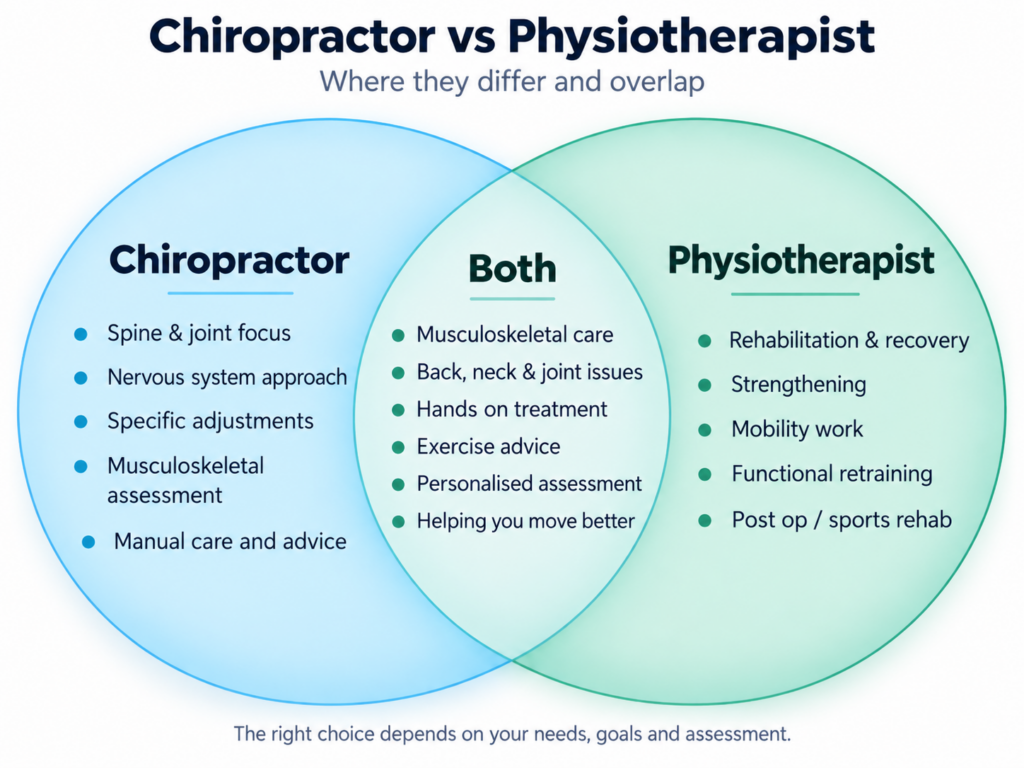
The easiest way to understand the different is to look at where the two professions overlap and where their emphasis tends to differ.
Wondering Whether Chiropractic Is Right for You?
You don’t need to diagnose yourself before you walk through our door.
And you don’t need to be in agony either.
Maybe you have an obvious problem.
Maybe something keeps cropping up.
Maybe you simply want to understand how your spine and body are functioning.
Your first visits at Life Balance give us time to hear what’s going on, assess you and explain what we find.
From there, we can talk about what chiropractic could look like for you.
No generic plan.
No assumption that everybody wants the same thing.
Just a proper conversation about where you are now and where you’d like to be.

Is it better to see a chiropractor or physiotherapist?
Neither is automatically better. It depends on what you need help with, your health history and what an assessment shows. Physiotherapy may be more appropriate when you need structured rehabilitation, strengthening or post-operative recovery, while chiropractic may be worth considering for musculoskeletal problems involving the spine, joints and movement.
How do I know if I need a chiropractor or physio?
Start by thinking about what you need help with rather than choosing based on the professional title alone. A physio may be a good starting point for rehabilitation, strengthening or return-to-sport work, while a chiropractor may be worth considering if you want an assessment focused on the spine, joints and musculoskeletal function. If you are unsure, a good practitioner should assess you and explain whether another type of care may be more appropriate.
Should I see a chiropractor or physio for lower back pain?
Both chiropractors and physiotherapists may work with people experiencing lower back pain. The right choice depends on your symptoms, goals and what is contributing to the problem. Good care should consider movement, exercise, self-management and progress rather than relying on one treatment technique alone.
Can a chiropractor and physiotherapist work together?
Yes, they can. At Life Balance, Hope works with many people who also see a physiotherapist, and the two approaches can sometimes complement each other because they may focus on different aspects of care. That does not mean everyone needs both, each part of your care should have a clear purpose.
When should I not see a chiropractor?
Chiropractic may not be the right first step if your symptoms are severe, unexplained, rapidly worsening, linked to significant trauma or accompanied by other concerning symptoms. In those situations, medical assessment may be more appropriate. A responsible chiropractor should explain when chiropractic is not suitable and guide you towards the right type of care.
What should I look for when choosing a chiropractor?
Look for someone who is registered with the General Chiropractic Council, explains their findings clearly, discusses your options and costs, and monitors your progress. You should also feel comfortable asking what happens if you do not improve and whether they would refer you to another healthcare professional if needed.
Contact
53 Lagland Street, Poole, Dorset, BH15 1QD